
Buy 5 or More Products! Save 25% On Total.
 Buy 3 or More Products! Save 10% On Total.
 Free Shipping! No Minimum Order.
Blog Empty Image

Oxygen is a drug and therefore requires prescribing in all but emergency situations. In the emergency situation oxygen prescription is not required.

Before oxygen therapy is prescribed there are guidelines or criteria that must be met. These criteria involve a blood test. (These blood test criteria must also be met for Medicare and other insurers to pay for the oxygen costs.) Medical experts produced the criteria. They establish what the levels of oxygen in the blood must be for oxygen therapy to be needed.


Oxygen is a drug and therefore requires prescribing in all but emergency situations. In the emergency situation oxygen prescription is not required.

Before oxygen therapy is prescribed there are guidelines or criteria that must be met. These criteria involve a blood test. (These blood test criteria must also be met for Medicare and other insurers to pay for the oxygen costs.) Medical experts produced the criteria. They establish what the levels of oxygen in the blood must be for oxygen therapy to be needed.
 
These guidelines describe three conditions that require the use of oxygen therapy:

1. PaO2 is less than or equal to 55 mmHg. Or hemoglobin oxygen saturation (SaO2) measured by pulse oximeter is less than or equal to 88 percent when breathing room air at rest.
 
2. PaO2 of 56-59 mmHg. Or if the hemoglobin oxygen saturation (SaO2) is equal to or greater than 89 percent when linked to specific conditions. These may include Cor Pulmonale, congestive heart failure or erythrocytosis. (With a hematocrit of greater than 56 percent.) (Erythrocytosis means there are more red cells in the blood than normal. Hematocrit measures the percentage of cells in a sample of blood.)
 
3. Some individuals do not qualify for oxygen therapy while at rest. But they may require oxygen while walking, exercising or during sleep. Oxygen therapy is needed in these cases when the hemoglobin oxygen saturation (SaO2) falls to less than or equal to 88 percent. Also, for the costs of oxygen to be covered by insurance there must be proof that the oxygen therapy used during exercise or sleep improves the individual's hypoxemia.
 
A physician must write a prescription for oxygen therapy prior to delivery. The prescription will indicate the flow rate, how much oxygen you need per minute -- referred to as liters per minute (LPM) -- and when you need to use oxygen.

Also necessary is Diagnosis, portability (if needed), and length of need. Some people use oxygen therapy only while sleeping, others only while exercising, and still others need oxygen continuously.

Your physician will order a blood test or oximetry test that will indicate what your oxygen level is and help determine what your needs are. A written prescription is required prior to delivery.

Certain insurance polices may pay for all your oxygen, but payment is based on laboratory results, diagnosis, and other information. The information listed below will help you to determine insurance coverage.
 
Medicare – In addition to a prescription, Medicare requires a Certificate of Medical Necessity (CMN) to be filled out by your physician. CMN Oxygen requirements are as follows:
 
1.      Length of need.
2.      Diagnosis, a respiratory ailment showing the need for oxygen.
3.      Oxygen Blood Gas to be 56-59 or below, or Oxygen Saturation level to be 89 or below.
4.      How the test was taken, room air, during exercise, or while sleeping.
5.      The testing facility where blood gasses or oximetry was performed.
6.      Portability if needed.
7.      Liter flow prescribed.
8.      Physicians Signature.
9.      Date.

Blog Empty Image

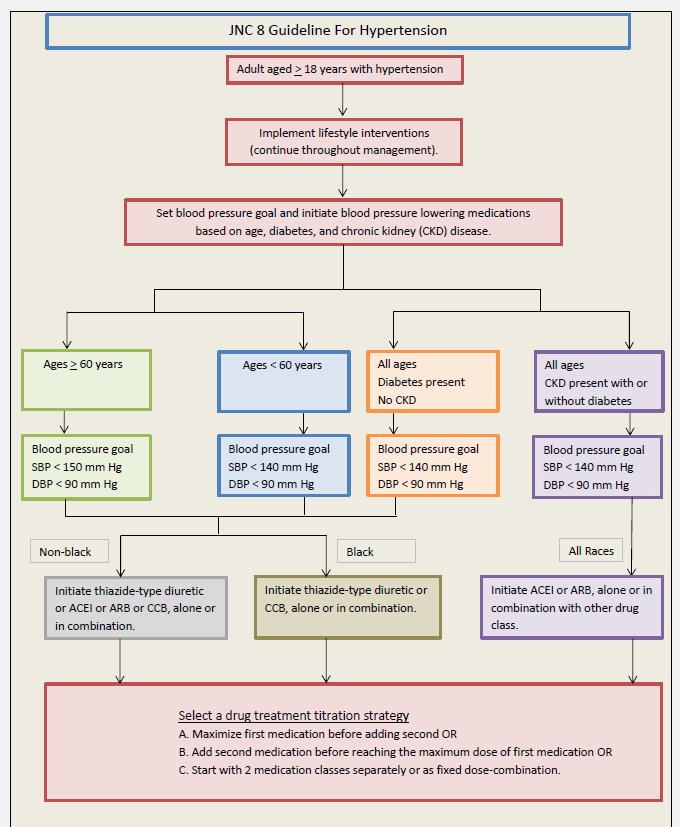
Updated hypertension recommendations from panel members previously appointed to the Eight Joint National Committee (JNC 8) raised blood pressure goals in adults age 60 and older to less than 150/90 mm Hg, with patients younger than 60 years old (including those with chronic kidney disease and diabetes) having a target of less than 140/90 mm Hg. In nonblack individuals, initial treatment should include a thiazide-type diuretic, calcium channel blocker (CCB), ACE inhibitor, or angiotensin receptor blocker (ARB). Treatment should start with a thiazide-type diuretic or CCB in black patients, including those with diabetes.

JNC 8 New Guideline Hypertension Chart


Updated hypertension recommendations from panel members previously appointed to the Eight Joint National Committee (JNC 8) raised blood pressure goals in adults age 60 and older to less than 150/90 mm Hg, with patients younger than 60 years old (including those with chronic kidney disease and diabetes) having a target of less than 140/90 mm Hg. In nonblack individuals, initial treatment should include a thiazide-type diuretic, calcium channel blocker (CCB), ACE inhibitor, or angiotensin receptor blocker (ARB). Treatment should start with a thiazide-type diuretic or CCB in black patients, including those with diabetes.

JNC 8 New Guideline Hypertension Chart


Blog Empty Image

On September 9, 2014, the DEA published a new rule that implements the Secure and Responsible Drug Disposal Act of 2010. This new rule will allow patients to return to pharmacies the drugs they no longer need, and prevent those drugs from being accessed by abusers....


On September 9, 2014, the DEA published a new rule that implements the Secure and Responsible Drug Disposal Act of 2010. This new rule will allow patients to return to pharmacies the drugs they no longer need, and prevent those drugs from being accessed by abusers.

Here are the basics of the rule:

1. Retail and hospital pharmacies, as well as other DEA registrants, may modify their DEA registration to become authorized collectors of unneeded prescription drugs.

2. Registered collectors may operate a collection receptacle at their registered location.

3. Pharmacies may operate collection receptacles at long-term care facilities.

4. Registration as a collector is optional. No pharmacy is required to do this.

For additional information, refer to the DEA Federal Register notice: https://www.federalregister.gov/articles/2014/09/09/2014-20926/disposal-of-controlled-substances.


Blog Empty Image

Drug Enforcement Administration (DEA) has published its final rule rescheduling hydrocodone combination products from Schedule III to Schedule II in the Federal Register.

The change imposes Schedule II regulatory controls and sanctions on anyone handling hydrocodone combination products, effective October 6, 2014. DEA first published the proposed rules in March 2014, in response to a Food and Drug Administration recommendation.

DEA received almost 600 public comments regarding the proposed rules after they were published, with a small majority of the commenters supporting the change, a DEA press release notes.


Drug Enforcement Administration (DEA) has published its final rule rescheduling hydrocodone combination products from Schedule III to Schedule II in the Federal Register.

The change imposes Schedule II regulatory controls and sanctions on anyone handling hydrocodone combination products, effective October 6, 2014. DEA first published the proposed rules in March 2014, in response to a Food and Drug Administration recommendation.

DEA received almost 600 public comments regarding the proposed rules after they were published, with a small majority of the commenters supporting the change, a DEA press release notes.


Blog Empty Image

Under a final rule (PDF) published in the Federal Register, the pain reliever tramadol is now classified as a Schedule IV controlled substance (CS).

Starting August 18, 2014, Drug Enforcement Administration (DEA) will require manufacturers to print the “C-IV” designation on all labels that contain 2- [(dimethylamino)methyl]-1-(3-methoxyphenyl)cyclohexanol (tramadol), including its salts, isomers, and salts of isomers.

The agency notes that every “DEA registrant who possesses any quantity of tramadol on the effective date of this final rule must take an inventory of all stocks of tramadol on hand as of August 18, 2014, pursuant to 21 U.S.C. 827 and 958, and in accordance with 21 CFR 1304.03,1304.04, and 1304.11 (a) and (d).” In addition, all “prescriptions for tramadol or products containing tramadol must comply with 21 U.S.C. 829, and be issued in accordance with 21 CFR part 1306 and subpart C of 21 CFR part 1311 as of August 18, 2014.”

National Association of State Controlled Substances Authorities notes (PDF) that several states have already classified tramadol as a CS. To “provide a reasonable time for registrants to comply with the handling requirements” for a Schedule IV CS, DEA established the effective date of the final rule as 45 days from the date of publication.


Under a final rule (PDF) published in the Federal Register, the pain reliever tramadol is now classified as a Schedule IV controlled substance (CS).

Starting August 18, 2014, Drug Enforcement Administration (DEA) will require manufacturers to print the “C-IV” designation on all labels that contain 2- [(dimethylamino)methyl]-1-(3-methoxyphenyl)cyclohexanol (tramadol), including its salts, isomers, and salts of isomers.

The agency notes that every “DEA registrant who possesses any quantity of tramadol on the effective date of this final rule must take an inventory of all stocks of tramadol on hand as of August 18, 2014, pursuant to 21 U.S.C. 827 and 958, and in accordance with 21 CFR 1304.03,1304.04, and 1304.11 (a) and (d).” In addition, all “prescriptions for tramadol or products containing tramadol must comply with 21 U.S.C. 829, and be issued in accordance with 21 CFR part 1306 and subpart C of 21 CFR part 1311 as of August 18, 2014.”

National Association of State Controlled Substances Authorities notes (PDF) that several states have already classified tramadol as a CS. To “provide a reasonable time for registrants to comply with the handling requirements” for a Schedule IV CS, DEA established the effective date of the final rule as 45 days from the date of publication.


Blog Empty Image

Carisoprodol is now CIV Controlled Drug...


A Drug Enforcement Administration (DEA) announcement provides information regarding the scheduling of carisoprodol, effective as of January 11, 2012.

The DEA Final Rule making the drug a Schedule IV controlled substance was published December 12, 2011, and states that effective January 11, 2012, all prescriptions for drugs containing carisoprodol shall comply with DEA regulations.

Specifically, a pharmacy may only fill or refill a prescription for a drug containing carisoprodol if all of the following requirements are met:

1. the prescription was issued for a legitimate medical purpose by a DEA-registered practitioner acting in the usual course of professional practice (21 CFR §1306.04);

2. the prescription contains all the information required by 21 CFR §1306.05; and

3. the number of refills authorized by the prescribing practitioner is five or less (21 USC §829(b)).


Blog Empty Image

FDA Issues New Guidelines for Sleep Aids Containing Zolpidem...


Food and Drug Administration (FDA) has issued new dosing recommendations for sleep aids containing Zolpidem. The new recommendations are based upon new data that shows that when taken at night, blood levels of Zolpidem remain high enough in the morning to impair activities that require alertness, such as driving.


The new guidelines halve the dosage for women because the new data showed that their bodies take longer to eliminate the drug.


FDA urges drug manufacturers and health care providers to follow the new dosing instructions, which apply to brand name and generic drugs containing Zolpidem:


Ambien®, EdluarTM, and Zolpimist®: 5 mg for women, 5 mg or 10 mg for men
Ambien CR®: 6.25 mg for women, 6.25 mg or 12.5 mg for men


Additionally, manufacturers of these drugs have been instructed to follow the new guidelines and print new patient information drug labels containing the new recommendations.


Blog Empty Image

Reprinted from the April 2009 Nevada State Board of Pharmacy Newsletter.

Although buprenorphine is not approved for use in pain, pharmacists are seeing an increasing number of prescriptions for this use...


Reprinted from the April 2009 Nevada State Board of Pharmacy Newsletter.

Although buprenorphine is not approved for use in pain, pharmacists are seeing an increasing number of prescriptions for this use. Rather than prescribed as a daily dose for addiction, it is usually given three to four times daily for pain. As you are all aware, buprenorphine prescribed for addiction requires the practitioner to have an “X” Drug Enforcement Administration (DEA) number, indicating special training in its use. It is legal for you to fill a buprenorphine prescription for pain with the prescriber’s regular DEA number just like all other Schedule III drugs. Your duty is to ensure that the prescription is indeed for the treatment of pain, which should hopefully be noted in the directions. Since buprenorphine can displace opioid agonists, watch for interactions that may precipitate withdrawal.


page  < 1 2 3 4 5 6 >