
Buy 5 or More Products! Save 25% On Total.
 Buy 3 or More Products! Save 10% On Total.
 Free Shipping! No Minimum Order.
Blog Empty Image

A critical path is one that reaches an end goal in the most direct possible manner. Water in the natural world, will always follow the line of least resistance - riding gravity along the most direct path. Often, we’re hampered throughout our own routines to recognize and chase our daily critical paths. It can be difficult to uncover the best route, and often, even if it is laid out before us – our responsibilities inhibit our progression.

A critical path is one that reaches an end goal in the most direct possible manner. Water in the natural world, will always follow the line of least resistance - riding gravity along the most direct path. Often, we’re hampered throughout our own routines to recognize and chase our daily critical paths. It can be difficult to uncover the best route, and often, even if it is laid out before us – our responsibilities inhibit our progression.


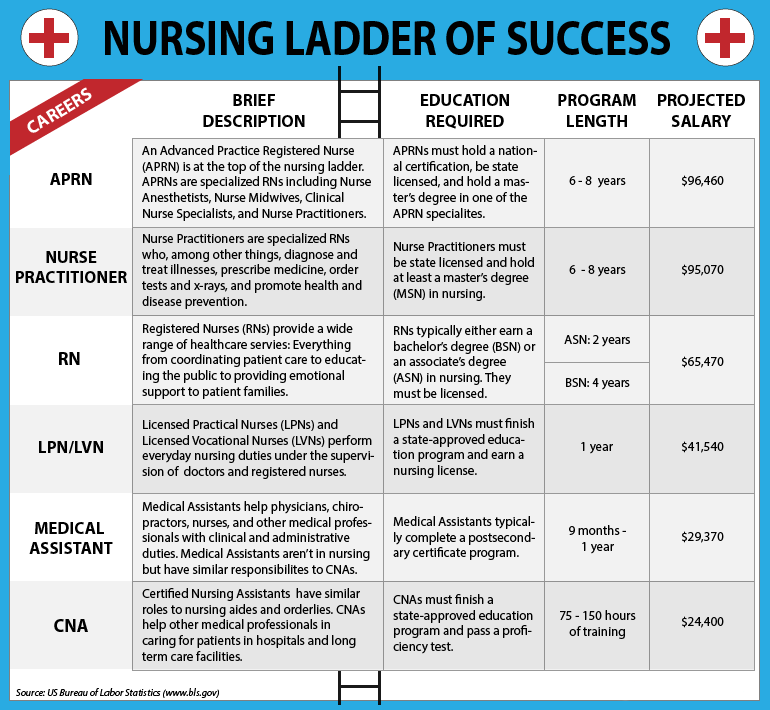
For a fortunate few though; for those selfless enough to sacrifice themselves for the care of the ill and the injured, there exists a beacon. This torch lighting the path of career progression for the CNA, is the “Nursing Ladder of Success”.  A career spent as a CNA, is very respectable. Few will work as hard. However, it is common for the CNA to climb higher through the ranks of the Nursing track.

Clinical settings are full of nursing professionals at various stages of career growth. As a CNA, buzzing through the hospital amongst a swarm of Medical Assistants, LPN’s, RN’s, and NP’s, we’re able to see exactly what’s possible if we continue with our training and coursework. As a pocket guide for the humming hospital hallway, we refer to our “Nursing Ladder of Success”. 

Citation: http://cnanursing.net


Blog Empty Image

Illegal Purchases of Controlled Substances Are Made Easier via Rogue Internet Drug Outlets, Reports NABP.


Last week, NABP released its Internet Drug Outlet Identification Program Progress Report for State and Federal Regulators: July 2016. The report explores the connection between the dangers of rogue internet drug outlets and the risk of overdose from illegally dispensed prescription controlled substances (CS), as well as possibly tainted counterfeit medicines.
 
Over the past eight years, NABP has worked to identify illegally operating websites to keep consumers safe and to try to decrease the overdoses and fatalities related to prescription drug misuse and abuse. Currently, 11,299 online drug outlets that sell prescription medications have been reviewed by NABP, and 95.79% have been classified as Not Recommended given that the websites are selling prescription medications out of compliance with state and federal laws and/or Association patient safety and pharmacy practice standards.
 
For the full report, visit the Not Recommended Online Pharmacies page in the Acquire Safely section of the AWARXE® Prescription Drug Safety website. You can avoid rogue internet drug outlets by buying from websites with a .pharmacy domain name. To see the list of approved entities with registered .pharmacy domain names, visit the Buying Safely section at www.safe.pharmacy. 


Blog Empty Image

Pharmacists were rated as the most trusted health care providers, according to a new consumer health survey. The results of the survey show that 60% of consumers trust pharmacists, 56% trust doctors, and 51% trust dentists. The Meyocks Health Survey reports that consumers trust the people who directly provide health care more than others in the health care system. Pharmacists had the highest trust rate and the lowest distrust rate among other groups in the survey, notes Drug Store News.


Pharmacists were rated as the most trusted health care providers, according to a new consumer health survey. The results of the survey show that 60% of consumers trust pharmacists, 56% trust doctors, and 51% trust dentists. The Meyocks Health Survey reports that consumers trust the people who directly provide health care more than others in the health care system. Pharmacists had the highest trust rate and the lowest distrust rate among other groups in the survey, notes Drug Store News.


Blog Empty Image

North Carolina and Texas Sign Legislation to Make Naloxone More Accessible to Patients


New legislation in North Carolina and Texas make naloxone, the opioid overdose reversal drug, more accessible to patients. North Carolina Governor Pat McCrory signed Senate Bill (SB) 734 into law on June 20, 2016, which authorizes the state health director to prescribe an opioid antagonist using a statewide standing order.

Under the former law, only a practitioner was authorized to prescribe an opioid antagonist pursuant to a standing order. SB 734 became effective the same day, according to the North Carolina Health and Human Services press release.
 
Beginning August 1, 2016, pharmacists in Texas will be authorized to dispense naloxone to patients under a standing order. The legislation will require pharmacists to complete a one-hour course accredited by the Accreditation Council for Pharmacy Education and in coordination with the Texas Pharmacy Association, according to a press release.

SB 1462 states an authorized prescriber may prescribe an opioid antagonist through a standing order. Medical doctors have unlimited, independent prescribing authority in every state. NABP’s 2016 Survey of Pharmacy Law states that pharmacists in Texas may perform specific acts relating to drug therapy management under written protocol from a practitioner including implementing or modifying therapy.


Blog Empty Image

Delaware Law Requires ID to Buy Certain Cough Medicines


A new Delaware law restricts the sale of over-the-counter (OTC) medicines containing dextromethorphan (DXM) to those aged 18 and older.

Intended to reduce abuse of the cough suppressant among teens, the law requires an ID to be presented at the point of purchase.

Delaware is the 12th state to impose a DXM restriction, reports Drug Store News.


Blog Empty Image

New Hampshire Pharmacies May Establish Drug Take-Back Programs Under New Law


Retail pharmacies in New Hampshire are authorized to establish pharmaceutical drug take-back programs if their program meets certain federal requirements.

House Bill (HB) 1490 was signed into law by Governor Maggie Hassan and is effective August 6, 2016. Under HB 1490, a registered pharmacy may establish a drug take-back program to collect controlled and non-controlled pharmaceutical drugs.

New Hampshire RSA 318-E:1 defines “pharmaceutical drug” as a prescription or OTC drug, including controlled drugs.


Blog Empty Image

Alaska Regulates Sale of Dextromethorphan Products to Adults, Requires Prescription for Persons Under 18 Years of Age.


The sale of products containing dextromethorphan in Alaska is restricted to individuals 18 years of age or older under a new law. House Bill 125 states products containing dextromethorphan may be sold if the person is under 18 years of age and has a prescription for the product from a licensed practitioner.

Alaska is the 11th state to restrict the sale of products containing dextromethorphan to adults and to require a prescription from a practitioner for individuals younger than 18 years, reports the American Pharmacists Association.


Blog Empty Image

Pharmacies in West Virginia Will Be Allowed to Dispense Opioid Antagonists Pursuant to Protocol Under New Law.


Pharmacies in West Virginia will be able to dispense naloxone, the opioid overdose reversal drug, pursuant to a protocol beginning June 10, 2016. Under the new law, a pharmacist or pharmacy intern is authorized to dispense an opioid antagonist pursuant to a protocol.
 
The law states the West Virginia Board of Pharmacy is required to develop a protocol requiring patient counseling, educational materials, and documentation of distribution in the West Virginia Controlled Substances Monitoring Program database. In addition, the Board is required to revise existing reporting requirements, provide limited liability to pharmacists and pharmacy interns, and reorganize existing code language.
 
West Virginia codes to be amended and reenacted include Chapter 16, Article 46, Section 3; Chapter 16, Article 46, Section 5; and Chapter 16, Article 46, Section 6. The law also adds a new section: Chapter 16, Article 46, Section 3a. Senate Bill 431 was signed into law by Governor Earl Ray Tomblin in March 2016 and takes effect June 10, 2016.


Blog Empty Image

Pharmacists in New Jersey Would Be Able to Dispense Certain Contraceptives Under Proposed Law.


Pharmacists in New Jersey would be able to dispense self-administered hormonal contraceptives pursuant to a standing order under a proposed New Jersey bill. Senate Bill 1073/2060 would require the New Jersey State Board of Pharmacy and Board of Medical Examiners to jointly develop procedures and protocols.
 
Under the proposed law, the standardized procedures and protocols would require a patient to use a self-screening tool to identify patient risk factors for the use of self-administered hormonal contraceptives, based on the current US Medical Eligibility Criteria for Contraceptive Use developed by the Centers for Disease Control and Prevention.
 
The standardized procedures and protocols would also require a pharmacist, upon furnishing a contraceptive to a patient or upon determining that a contraceptive is not recommended, to refer the patient to the patient’s primary care provider or to an appropriate and nearby medical clinic.
 
To date, the bill, sponsored by Senators Shirley K. Turner and Joseph F. Vitale, has been referred to the Senate Budget and Appropriations Committee.


page  < 1 2 3 4 5 6 >